
Climate change has prompted a rethink, particularly in the field of landscape architecture. Through the use of new plant species, green corridors and intelligent water management, the microclimate is cooled and the formation of heat islands in summer is prevented. Matthias Dilger has been a landscape architect and urban planner at AS+P since 2008. In this interview, the qualified engineer reveals how the new concepts for socially and climate-friendly open-space planning are being incorporated into FRANKFURT WESTSIDE – and what would have been done differently 30 years ago.
Let’s start small. You’re a landscape architect – have you designed your garden or balcony in any special way?
(laughs) I have to admit, to my shame, that it’s my wife who has the green fingers. She’s completely transformed our balcony. I tend to be in charge of the bigger projects; it’s a small Frankfurt balcony, but it’s very green and cosy.
Larger projects – which brings us to the topic of Frankfurt Westside. The former Griesheim industrial park covers a total of 73 hectares. How much open space is available there?
I can’t put an exact figure on it. The important thing is that, thanks to our consistent interdisciplinary collaboration at AS+P, we are able to maximise the amount of open space in our projects, working alongside our urban and transport planners. This has a lasting impact on the overall planning process and enhances the positive environmental and social benefits. What’s more, we’re able to connect a whole stretch of the Main riverbank to this neighbourhood, which offers enormous design possibilities.
“Twenty years ago, they would simply have cleared everything away and built something new here”
How are socially and environmentally friendly open spaces being created on the site of the former Griesheim industrial estate?
We have four multifunctional axes, which form the lifelines of the neighbourhood. There will be social spaces, outdoor workspaces, podiums and event areas for larger gatherings. We are also planning quiet zones for relaxation, as well as sports and leisure facilities. An important feature here is the banks of the Main. This connects Frankfurt Westside to the Main cycle paths. We are also planning a play and sports area on the riverbank – and another multifunctional space at the harbour, where events of all kinds can be held. This will benefit not only future employees, but also local residents.
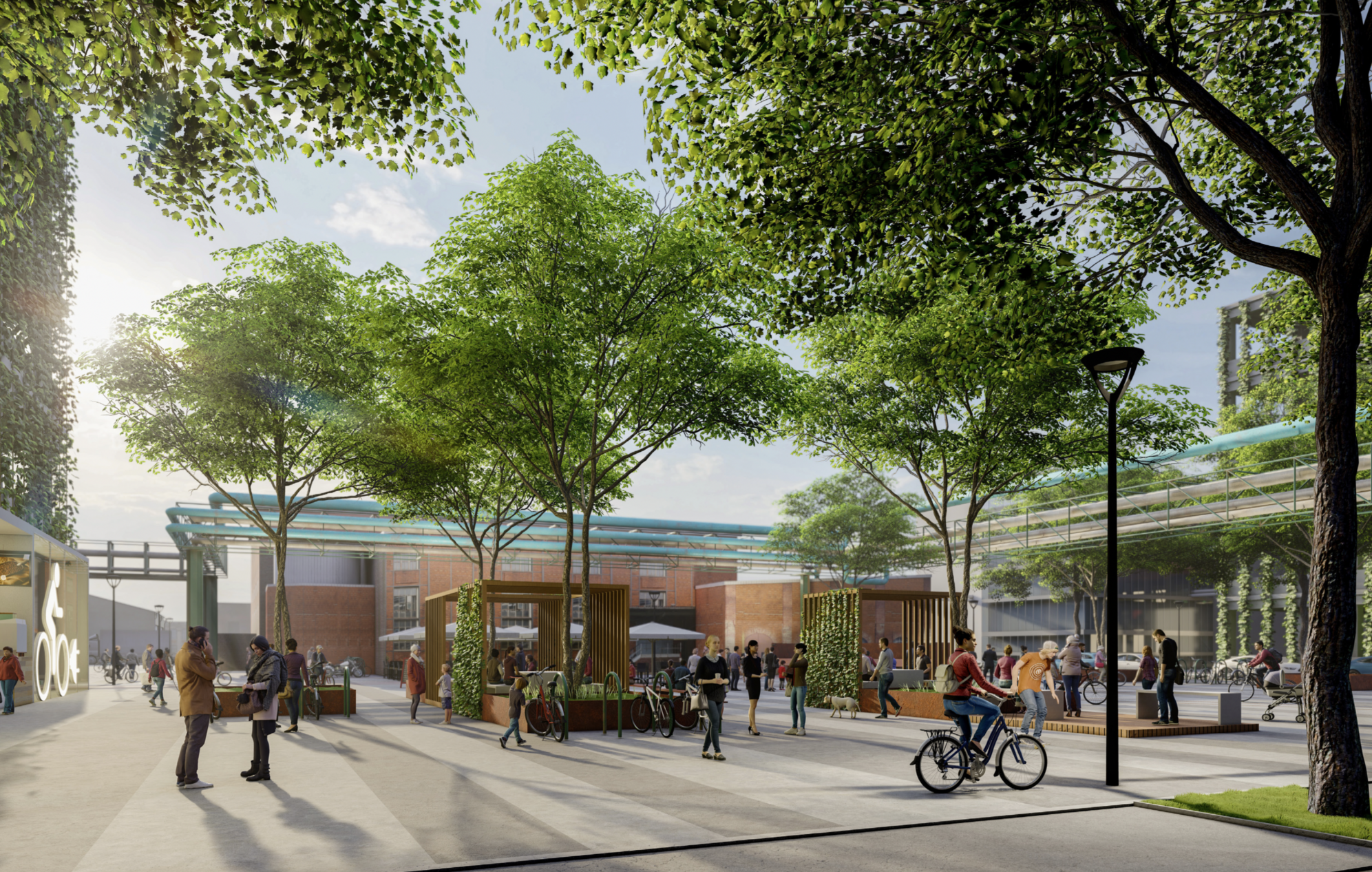
“WE ASK OURSELVES: WHICH TREES AND PLANTS WILL STILL HAVE A CHANCE IN 20 OR 30 YEARS’ TIME?”
The site is home to industrial heritage sites that are sure to delight loft enthusiasts. How do you intend to manage this heritage?
Frankfurt Westside is a redevelopment project that builds on 150 years of industrial history. When you’re out there on site, you can still sense that intensive manufacturing has taken place there for generations. It is important to us not to overlook this history as we transform the site, and to treat these industrial relics with care. This is how we are preserving buildings and industrial structures, particularly along the main axes.
Combined with modern landscape design and materials, this creates a unique character that can only emerge from the interplay of different eras, building materials and atmospheres. For example, we try to salvage as many bricks as possible from the numerous brick buildings, store them, and use them in the future to build paving, walls or benches, etc. This is what we mean by the cradle-to-cradle approach: utilising grey energy that is already there.
We have seen that summers are getting hotter and hotter as a result of climate change. How can landscape architecture help in this regard?
With the neighbourhood’s microclimate in mind, we are creating wide green corridors of fresh air along the axes, lined with trees and planting, leading from the banks of the Main into the area. Despite the contaminated sites, the appropriate methods will enable us to open up the surface. Through planted vegetation areas, we can thus retain water and allow it to evaporate. This has a cooling effect on the microclimate and prevents the formation of heat islands.
Nevertheless, it’s getting drier overall. You’re not going to plant any more of those thirsty birch trees, are you?
Exactly! As landscape architects, we always ask ourselves: which trees, shrubs and plants will still have a chance of surviving in an urban environment in 20 or 30 years’ time? Many native tree species are now struggling. The German Conference of Heads of Parks and Gardens, for example, has long been assessing street trees for their compatibility with urban and climatic conditions.
This has done away with the old belief that we should only plant native trees and shrubs. It is now widely accepted that we need to be more open-minded and flexible in order to ensure our cities have climate-resilient trees in the long term. For example, southern European species that can withstand our frosts are of particular interest here. We are also increasingly focusing on extensive meadows and shrub plantings – which require little water – rather than generously watered lawns.

Looking back, what might landscape architects have done differently 20 years ago?
A great deal has changed in recent years. Take the example of conversion and regeneration. Three decades ago, an old site – be it a barracks or an industrial site – was often simply cleared and something new built in its place. In fact, this is a subject very close to my heart. My professor at university was one of the first to put forward this idea: not to tear everything down, but to use the history to create a special atmosphere in a place.
‘We are giving a large section of the banks of the Main back to the city’
What appeals to you personally about the development of the former Griesheim industrial estate?
I am fascinated by the transformation of a former industrial site into an attractive neighbourhood, and by the opportunity this presents to return a large stretch of the Main riverbank to the city. I can well imagine that the west of Frankfurt will develop into a landmark in the future. Making this area accessible to the people of Frankfurt over the next few years, including the banks of the Main, and thus turning it into an attractive component of the urban fabric – that is truly something to look forward to.
Have you already found your future favourite spot at Frankfurt Westside?
Actually, there are some old petrol stations along one of the main roads that are really tall. When we went for a site visit, we were able to go up there. There’s a fantastic view of the skyline, the West Side and the Main. So if I had my pick, I’d choose that spot.
Thank you very much for the interview!
